
UK: Gurkoi Hawkmoth
Sphingonaepiopsis gurkoi Melichar & Řezáč, 2013, European Entomologist 4(4): 175.Type locality: Tajikistan, western Pamirs, Rushan area, 3400m, 10-20.vii.1996.
(Taxonomic note. In 2023 a 'new species' of Sphingonaepiopsis, namely Sphingonaepiopsis zolotuchini (Stshetkin & Korb, 2023), was described from Tajikistan (Peter the Great Mountains, near Ganishou, 2070m). This new species differed from the closely related S. kuldjaensis (Graeser, 1892) and S. gurkoi Melichar & Řezáč, 2013, in being lighter in colour than S. kuldjaensis and in having wider marginal borders on the hindwings than in S. gurkoi. Also, in the male genitalia, the shape of sacculus differed. In the new species it was formed like a cog; in the two other species it was rectangular or oval (Stshetkin & Korb, 2023).)
Holarctic; western Palaearctic region. Pleistocene refuge: Monocentric -- Turkestan refuge. Probably a pleistocene relict which evolved from an isolated population of Sphingonaepiopsis kuldjaensis (Graeser, 1892).
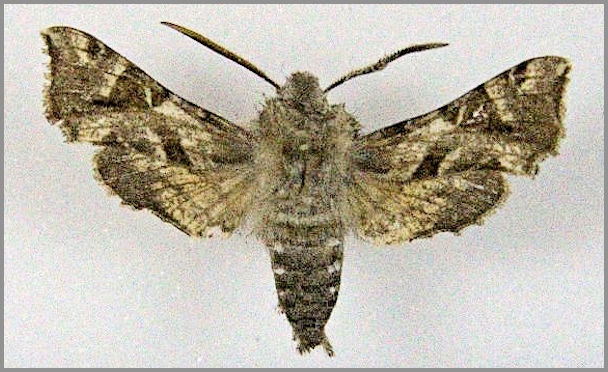
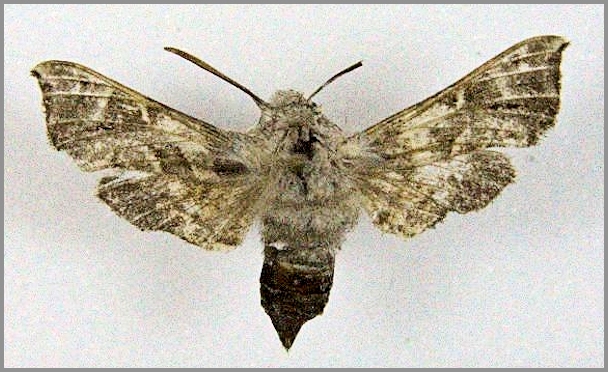
Wingspan: 38mm. Resembles Sphingonaepiopsis kuldjaensis, but forewings grey-brown, the lighter areas with a tinge of light orange. The basal and medial bands are dark brown. The vertical light line next to the medial band above M2 is narrower than in Sphingonaepiopsis asiatica (Melichar & Řezáč, 2013). The hindwings have a dirty grey-orange to light yellow ground colour, by which the new species differs fundamentally from Sphingonaepiopsis kuldjaensis, in which the hindwing ground colour is always light brown and orange. The outer edge is grey-brown with a width of approximately 3mm in the upper half, and the dark colouring disappears towards the lower part of the outer edge. Two parallel bands run laterally across the entire width of the wing through the central area of the hindwings. The body and thorax are the same colour as Sphingonaepiopsis kuldjaensis. On the posterior edge of the thorax is a 1mm wide white band separating it from the abdomen. There are visible paired white patches, each 1-1.5 mm long, on the first and second abdominal segments (Melichar & Řezáč, 2013).
In shape, the male genitalia are closer to those of Sphingonaepiopsis kuldjaensis than to any other species of the genus Sphingonaepiopsis from the Palaearctic. Sphingonaepiopsis gurkoi differs primarily in the shape of harpe, the upper rounded part of which is covered in coarse protuberances, and from the lower angle of which a ridge projects distally along the ventral edge of the valve, features that are wholly absent in Sphingonaepiopsis kuldjaensis. This latter trait is so striking that it is possible to diagnose this species solely on the basis of it (Melichar & Řezáč, 2013).
A montane species, occurring in Tajikistan at altitudes over 3500m in areas of mountain steppe (Melichar & Řezáč, 2013).
Tajik individuals have been captured during the first three weeks of July (Melichar & Řezáč, 2013).
OVUM: Unknown.
LARVA: Unknown.
Hostplants. Unknown.
PUPA: Unknown.
Unknown.
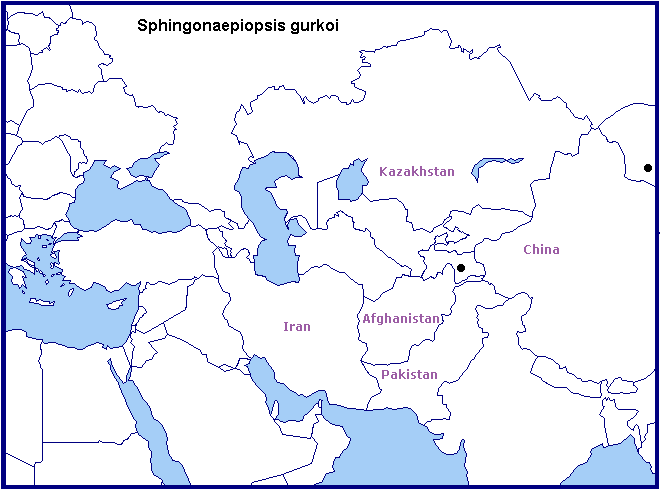
Confirmed from the Rushan area of Tajikistan (Melichar & Řezáč, 2013).
Note: The individual of this species originally listed by Pittaway & Kitching (this site) from western Mongolia has since been confirmed as being Sphingonaepiopsis kuldjaensis, as originally identified by Yakovlev, 2011; Yakovlev, Gus'kova, Doroshkin & Titov, 2015.
Extra-limital range. None.
 Return to species list