
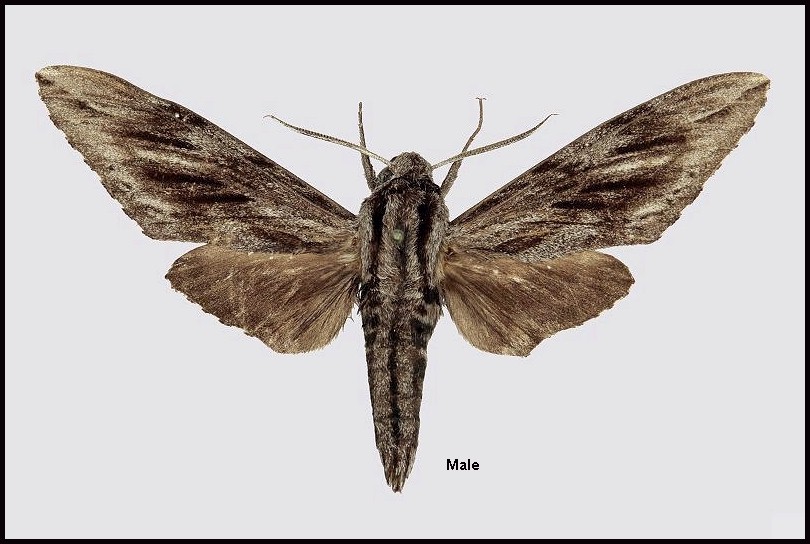

Sphinx centrosinaria Kitching & Jin, 1998, Tinea 15: 275. Type locality: China, Sichuan, Ya'an.
Wingspan: 76mm. In general colour and maculation, Hyloicus centrosinaria is almost identical to Hyloicus crassistriga Rothschild & Jordan, 1903 from Japan. However, Hyloicus centrosinaria can be readily distinguished by its more elongate and apically pointed forewing. Furthermore, Hyloicus centrosinaria is a larger moth (RFWL = 33mm) than either nominotypical Hyloicus crassistriga from Honshu (RFWL = 29mm) or the northern subspecies, Hyloicus crassistriga aino (Kishida, 1990), from Hokkaido (RFWL = 26-28mm). The harpe of Hyloicus centrosinaria is also quite similar to that of Hyloicus crassistriga aino. However, in this latter taxon, the ventral lobe is much less well-developed than it is in Hyloicus centrosinaria, being reduced to a short, blunt, triangular point. The harpe of Hyloicus crassistriga is even less like that of Hyloicus centrosinaria, having an acutely pointed dorsal lobe and a ventral lobe that is reduced to a small, sharp point. Kitching & Jin (1998) considered that these structural differences, together with the immense distance between the ranges of these two taxa (over 3000km), justified treating Hyloicus centrosinaria as a species, rather than as a subspecies of Hyloicus crassistriga.
In its elongate forewing, Hyloicus centrosinaria resembles Hyloicus formosana (Riotte, 1970) from Taiwan. However, Hyloicus centrosinaria lacks the general dusting of pale grey scales over the forewing upperside of Hyloicus formosana (which reduces the pattern contrast in this species), while the shape of the harpe of Hyloicus formosana is quite different from that of Hyloicus centrosinaria.
Nothing known except that males are drawn to light in conifer forests.
China: 19.vi (Xingou); 27.vi-2.vii (Ya'an); vii (Dechang).
OVUM: Unknown.
LARVA: Body apple-green, with three longitudinal white lines per side, with the ventro-lateral partially broken up into a line of 'blobs'. The dorso-lateral and ventro-lateral edged with black/grey, the dorsal pair bordering a dark mahogany-brown dorsal band. The green areas with fine white tubercles; the brown anal flap/claspers with fine black tubercles. First thoracic segment edged with blue frontad. Horn black, thin, slightly curved and tubercled. Head oval, light mahogany brown with yellow cheek stripes, which are bordered in front with darker brown. Very similar to that of the closely related Hyloicus formosana from Taiwan.
PUPA: Unknown.
Larval hostplants. Unknown, but most probably Pinaceae.
Unknown.
China: Sichuan (Ya'an; Abulandan Shan, near Dechang; Xingou; Giant Panda National Park, Baoxing County (Ji-Shen Wang, iNaturalist 2018)); Yunnan (Mianmian Shan, 20Km W Lake Lugu; Wumeng Shan, 20km N Baoshan village); Xizang/Tibet (Motuo National Park, near Motuo/Metok/Mêdog/Pemako; ?Mutu, Namjagbarwa region, 850m)
Endemic to Sichuan, Yunnan and Xizang/Tibet (Thierry Vaglia, pers. comm. 2007), southern China.
Part of the relict eastern Palaearctic fauna of montane southwest China. Closely related species are found in Japan (Hyloicus crassistriga Rothschild & Jordan, 1903) and Taiwan (Hyloicus formosana (Riotte, 1970)).
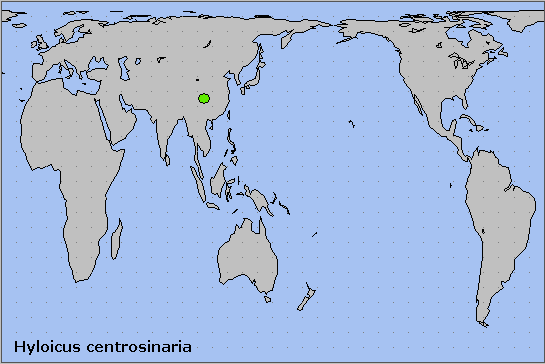
Holarctic; eastern Palaearctic region. Pleistocene refuge: Monocentric -- Yunnan refugium.
Return to Sphingidae of the Eastern Palaearctic species list