

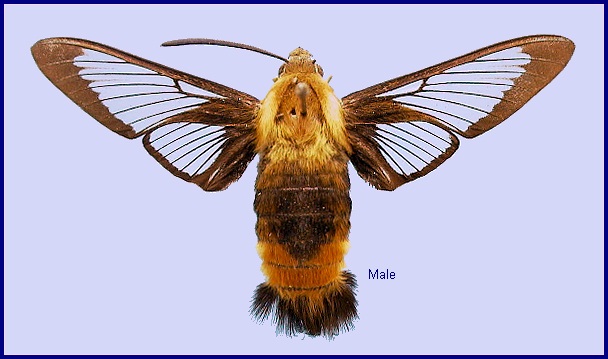
Hemaris staudingeri Leech, 1890, Entomologist 23: 81. Type locality: [China, Hubei,] Chang-Yang [Changyang].
Synonym. Haemorrhagia staudingeri kuangtungensis Mell, 1922.
Synonym. Hemaris staudingeri nigra Clark, 1922.
Base of forewing upperside black or nearly black; transparent discal cell not divided longitudinally by a scaled fold; crossveins not more heavily scaled than Cu; crossveins at apex of discal cell more heavily scaled than Cu; inner edge of marginal band even or dentate. Base of hindwing upperside black or nearly black. Anterior half of abdomen dorsally more or less black, contrasting strongly with the posterior segments. Hindtibia black except for the base.
In the male genitalia, uncus longer than in Hemaris fuciformis and Hemaris tityus, the two halves more deeply separate. Gnathos much broader, strongly asymmetrical, the right edge convex, the left concave beyond the middle, apex strongly dilated towards the left side. Juxta smooth, lacking small posteriorly directed teeth, produced ventrally into a pointed process. Left valve intermediate between of Hemaris fuciformis and Hemaris tityus, decidedly more slender than in Hemaris tityus, and somewhat spatulate; right valve as slender as in Hemaris fuciformis but ventral margin less deeply and more distantly sinuate, the sinus deeper than in Hemaris tityus, but nearly in the same place. Left harpe with very few bristles; right harpe ending in a long process as in Hemaris tityus, this process compressed except apically, strongly clubbed in dorsal and ventral view, much less so in lateral view, the thickened end armed with erect spines, of which those on the upperside are nearly as long as the process is apically broad. Phallus with an acutely pointed process as in Hemaris tityus.
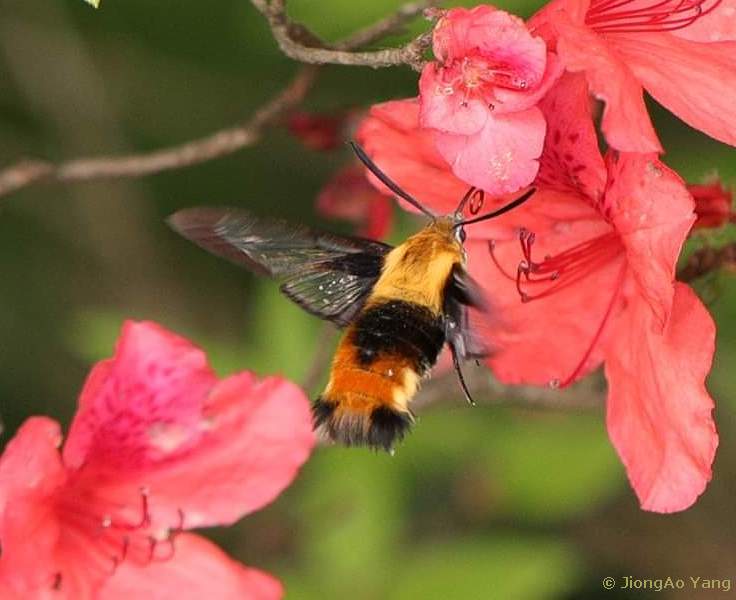
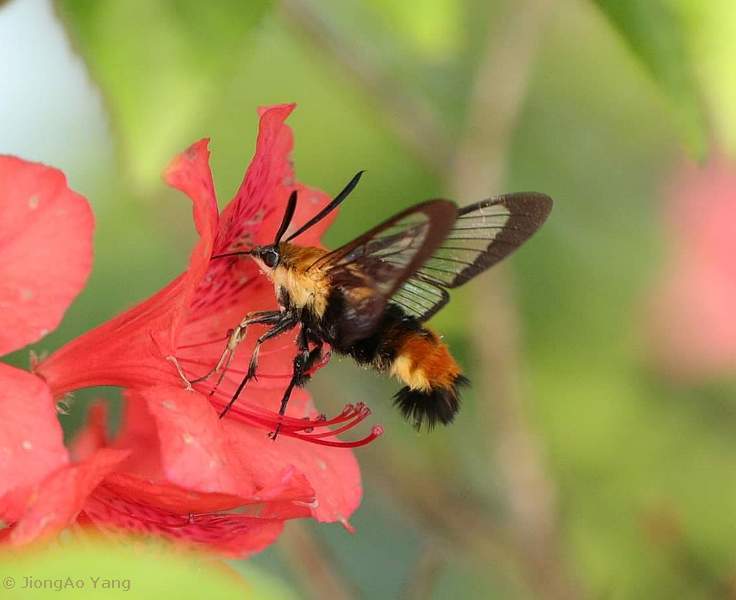
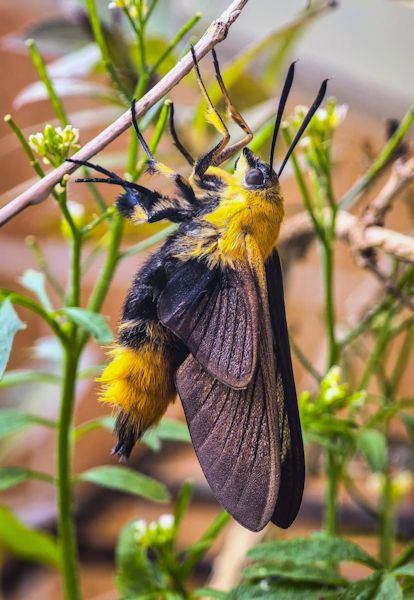
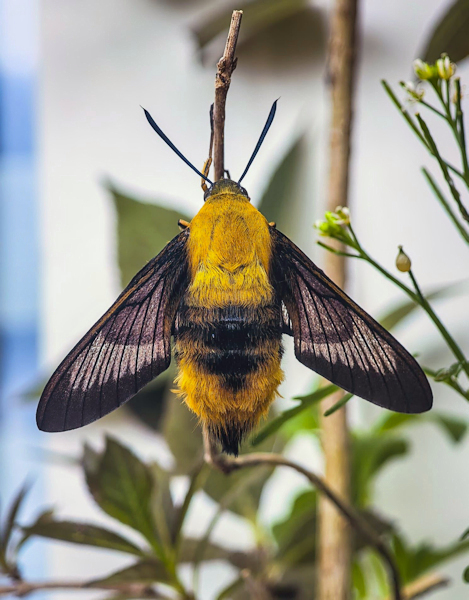
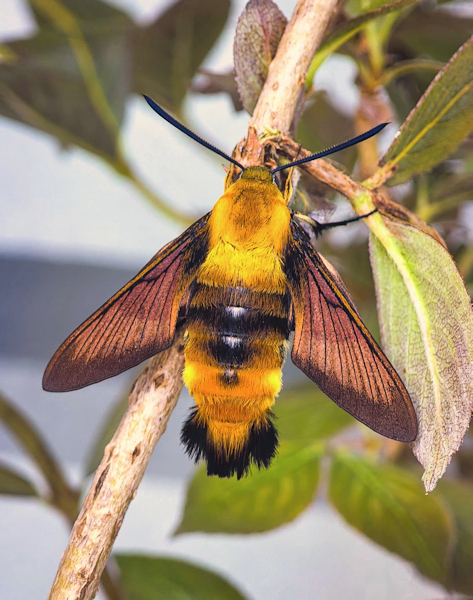
A slow-flying species which mimics the large Xylocopa carpenter bees which frequent the same nectar flowers. According to Serge Yevdoshenko (pers. comm. 2026), although this species reproduces on Weigela at around 1000-1200m altitude, the adult moths range both higher and lower in altitude in search of nectar-bearing flowers.

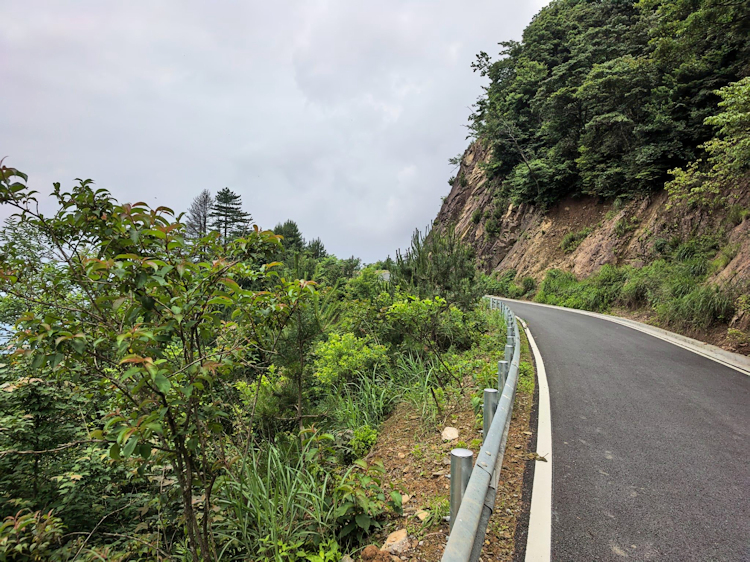
China: 21.iii-25.iv (Guangdong); iv-vi (Zhejiang); 15.v (Zhejiang); 29.vi (Gansu); 1.vii-10.viii (Zhejiang); vii (Shaanxi; Shanghai; Hubei; Hunan); 22.viii (Anhui); 2.ix (Zhejiang).
Mell (1935) recorded two generations for Zhejiang, flying in April-May and July-August.
OVUM: Unrecorded.
LARVA:

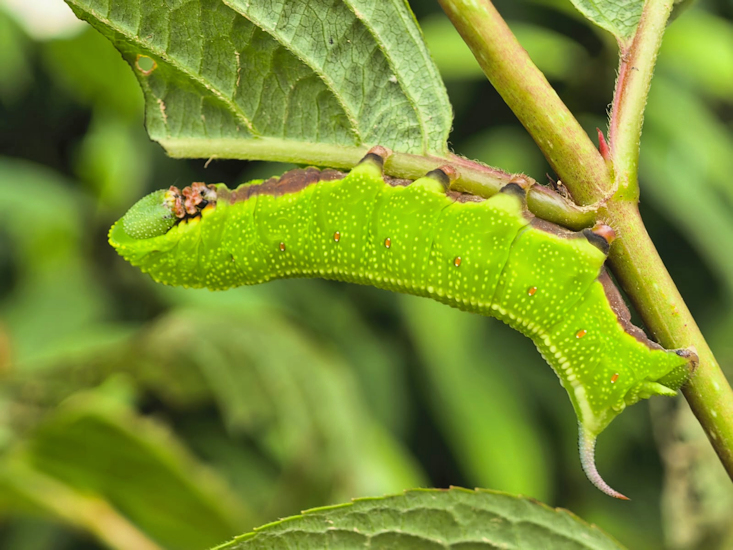
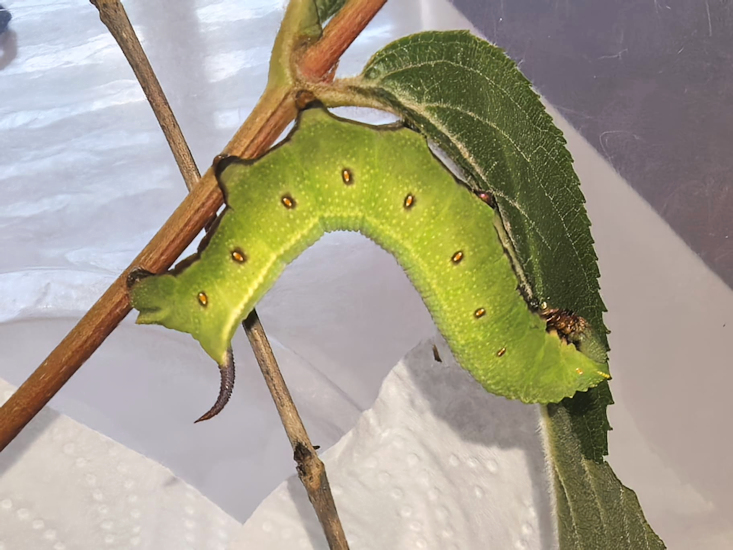

PUPA: 43--45mm.
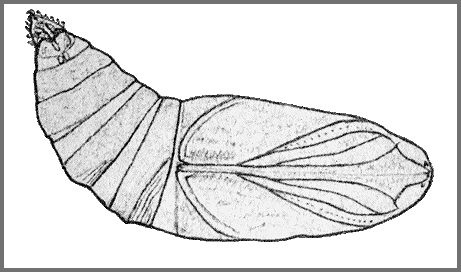
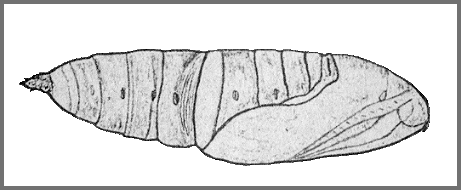
Larval hostplants. Recorded from Lonicera (Mell, 1922b). However, Serge Yevdoshenko (pers. comm. 2026) has confirmed that, like with the closely related Hemaris ottonis (Rothschild & Jordan, 1903), Lonicera is not the main host for this species in eastern China (Zhejiang, Kaihua County), having only found and reared it on Weigela [syn. Diervilla].
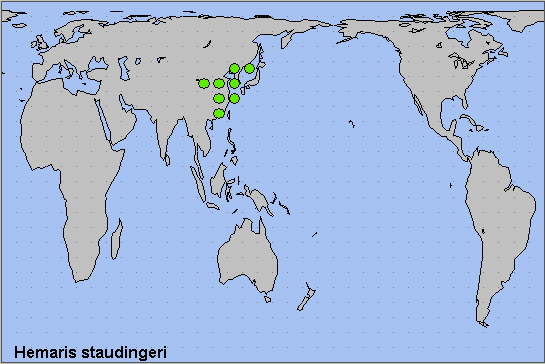
China: Shaanxi (Taibai Shan, 1700m; near Hanzhong, Daba Shan); Gansu (Longnan); Anhui (Huangshan Mts.); Shanghai; Zhejiang (Mogan Shan; Tianmu Shan; Henglingcun; Kaihua County, Qixizhen); Hubei (Changyang, 6000'); Chongqing (Xiushan); Hunan (Hengshan); Jiangxi (Guling); Guangdong (Man-tsi-shan = Mahntsishan = Maozifengzhen Mountain Forest, Nanxiong City).
Eastern and central China. [Records from the southern Russian Far East are erroneous and refer to Hemaris ottonis (Rothschild & Jordan, 1903), e.g. Streltzov & Dubatolov, 2000.]
 Return to Sphingidae of the Eastern Palaearctic species list