
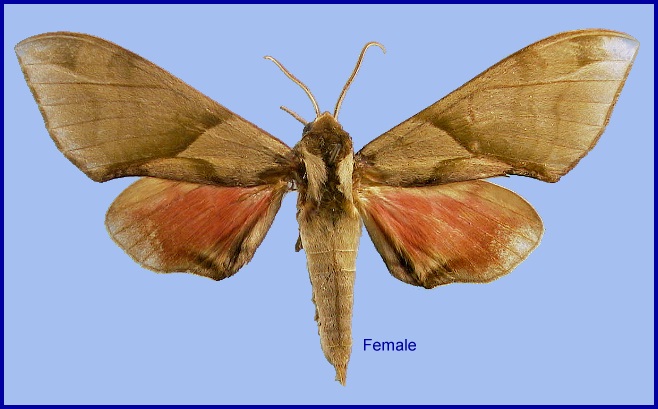
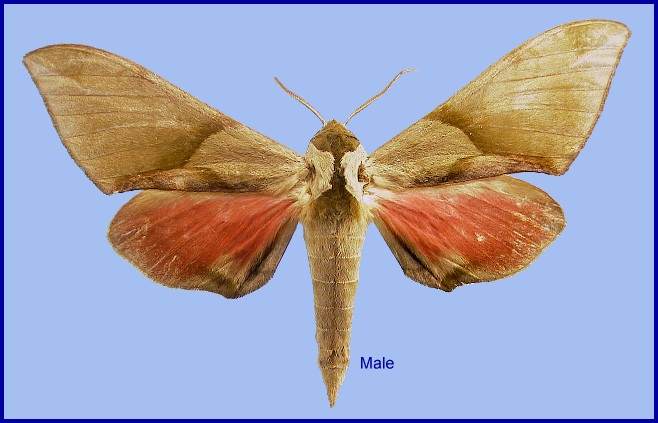
Callambulyx poecilus formosana Clark, 1935, Proc. New Engl. zool. Club 15: 24. Type locality: Formosa [Taiwan, Nantou Hsien], Hori [Puli].
Synonym. Callambulyx tatarinovii formosana Okano, 1958.
Note. Up until recently, three poorly differentiated subspecies were recognized; these have now been synonymized. The more heavily marked Clanis bilineata tsingtauica Mell, 1922, occurs in Japan and northern China as far south as Shaanxi and Zhejiang. The more lightly marked nominotypical subspecies, Clanis bilineata bilineata (Walker, 1856), has been recorded from Sichuan and Guangdong, from where it extends west to Nepal and south to southern India, Thailand and Vietnam. The status of the intervening Chinese populations from Hubei, Hunan, Jiangxi and Fujian remain to be ascertained (Pittaway and Kitching, 2000). The population on Taiwan is Clanis bilineata formosana Gehler, 1941 (Lin, 1989).
Wingspan: 56--70mm.
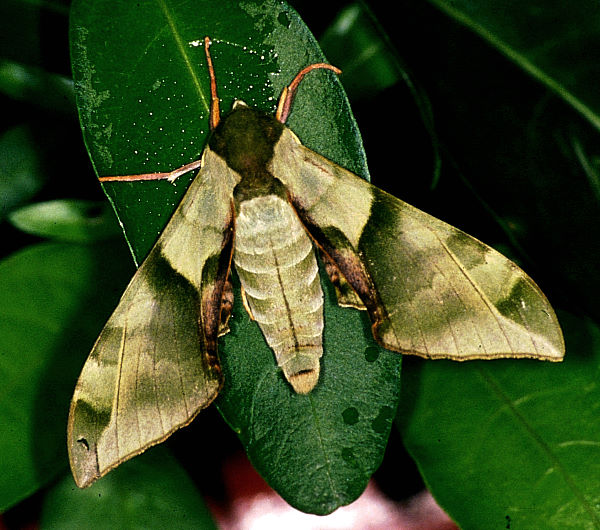
Taiwan: iii (Hualien Hsien); 30.xi (Nantou Hsien).
OVUM:
LARVA:
PUPA:
Larval hostplants. Zelkova serrata.
Taiwan: Hualien Hsien (Taroko National Park); Nantou Hsien (15km N Puli, Huisun Forest, 500m; Puli; Lushan Spa, 1200m); Kaohsiung Hsien (Shanping, 640m); Taoyuan Hsien (Galahe).
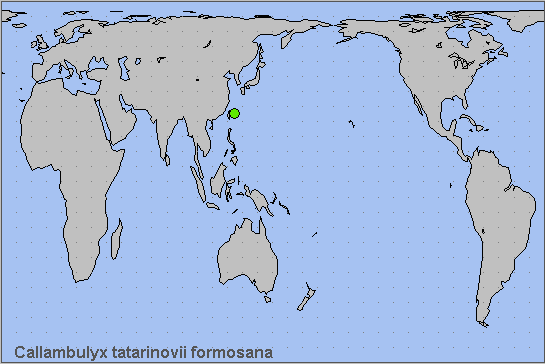
Endemic to Taiwan.
 Return to Sphingidae of the Eastern Palaearctic species list